


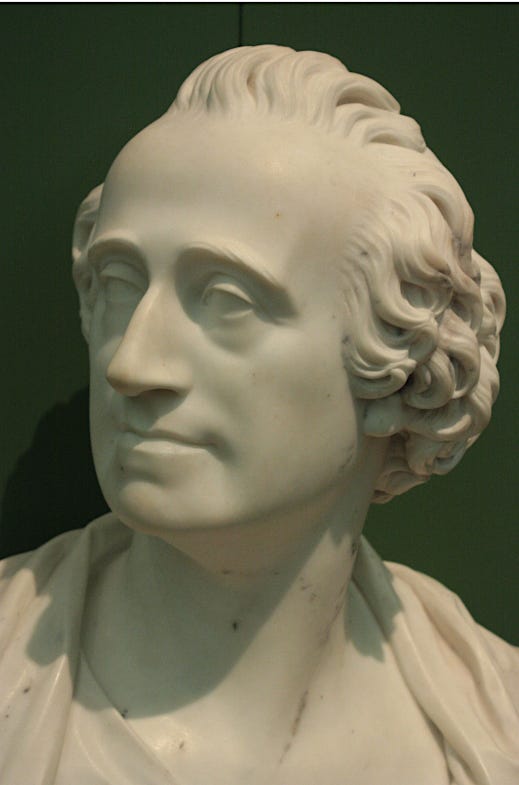
Today marks 250 years since the publication of An Inquiry into the Nature and Causes of the Wealth of Nations by Adam Smith. That’s a long time, but the influence of this book is hard to overstate. Few works of political economy have had consequences on the scale of this one. And while political economy itself seems to be less and less understood in today’s world, often replaced by mathematical economics designed to support existing policy, Smith did not simply write a book about commerce. He explained the mechanics of a new kind of society that was beginning to take shape across the Atlantic world.
In the eighteenth century most European governments still operated within the framework of mercantilism. Often, this is what we’ve poked fun at President Trump for appearing to support. Regardless, before Smith wealth was widely assumed to come from accumulation. States tried to hoard precious metals, restrict imports, and control trade through monopolies and chartered companies. Commerce existed, but it was tightly managed and often distorted by political privilege.
Smith argued that this understanding of wealth was fundamentally wrong. The prosperity of nations did not come from stockpiles of gold or from carefully managed trade balances. It came from productivity. It came from the capacity of ordinary people to produce more goods through specialization and exchange.
His discussion of the pin factory became the most famous example in the book. A single worker trying to make pins from start to finish could produce only a handful each day. Divide the process into specialized tasks and production multiplies. Workers gain skill in a narrow function. Time is saved moving between tasks. Tools improve. The result is an enormous increase in output.
This was not a minor observation about manufacturing. Smith was identifying the central mechanism behind modern economic growth. Specialization allows knowledge and efficiency to compound. As productivity increases, goods become cheaper, markets expand, and further specialization becomes possible.
Another insight in The Wealth of Nations was Smith’s explanation of how economic coordination occurs without central direction. Individuals pursuing their own interests still produce patterns of order through exchange. Supply adjusts to demand without the need for a central authority directing production. Smith described this process with the metaphor of an “invisible hand.”
This was a direct challenge to the economic thinking of the time. Mercantilist systems assumed that governments needed to orchestrate trade in order to secure prosperity. Smith believed the opposite. Governments that attempted to micromanage commerce usually produced monopolies, corruption, and inefficiency.
Much of the book is devoted to dismantling those arrangements. Smith had no patience for guild restrictions, chartered trading companies, or industries protected by political influence. These systems benefited small groups while limiting the productive potential of society as a whole.
It is sometimes forgotten how much of The Wealth of Nations is a critique of regulation and economic privilege.
The book also appeared at a moment when the structure of the Atlantic world was changing. It was published in 1776, the same year Britain’s American colonies declared independence in the American Declaration of Independence. The imperial trading system that had defined the previous century was under strain. New commercial relationships were emerging between Europe, North America, and the wider world.
Smith’s work helped explain the economic logic behind this transformation. Open exchange, expanding markets, and rising productivity offered a more durable foundation for prosperity than the old imperial system of restrictions and monopolies.
It is also important to remember that Smith did not see markets as operating in isolation from society. Before writing The Wealth of Nations, he published The Theory of Moral Sentiments, a study of ethics and human behavior. Smith believed economic life depended on trust, law, and shared moral expectations. Commercial societies function only when individuals believe agreements will be honored and institutions will enforce rules fairly.
In closing, another remarkable thing about Adam Smith is that he lived during one of the most intellectually fertile periods in Western history. The world he inhabited, and the people he associated with, were themselves extraordinary. Smith moved in circles that included figures such as Joshua Reynolds and Samuel Johnson, part of the remarkable intellectual life of the eighteenth century. He was widely noted in his own time for his intellect and his ability to explain complex ideas clearly. Two and a half centuries later his work remains part of the foundation of modern economic thought.
If you have not read this book before, clearly I am a fan. Here is a link to Project Gutenberg’s edition: https://www.gutenberg.org/ebooks/3300