


I’ve been critical of Thomas Piketty for some time (see here), and now I’m finding Gabriel Zucman equally annoying. Both are economists who are successful writers, but they’re much better at explaining their theories than translating them into successful public policy.
California’s proposed billionaire tax is a really great example of lofty ideas with really bad implementation and rationale. Cliff Asness recently raised an obvious question about the supposedly one-time nature of the tax. Does Zucman intend to campaign for making it permanent? And does he seriously expect people to believe that California’s appetite for taxing accumulated wealth will end with a single collection?
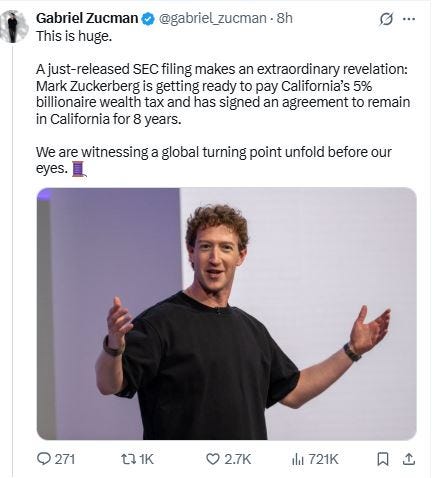
Meta's decision to create an entirely new class of nonvoting shares, partly to allow Mark Zuckerberg to pay California's proposed billionaire tax without sacrificing control of his own company, shows exactly what I consider a failure of economic policy. One of the world's most valuable companies restructured its cap table to address a tax that hasn't even passed. Zuckerberg was considering leaving California, and no doubt this was the final nail in the coffin, but Meta's board spent months negotiating a solution. Whatever your views, surely we should question a tax proposal that has already prompted this level of corporate financial engineering before collecting a single dollar.
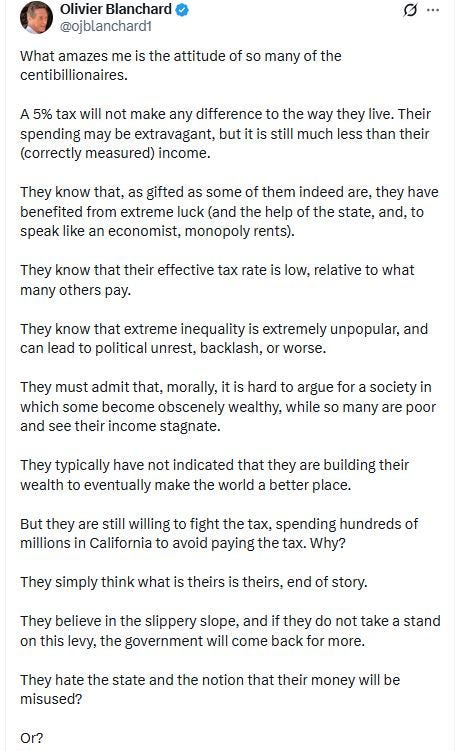
Then there’s Olivier Blanchard, who is astonished that billionaires would oppose a 5% wealth tax when they’re wealthy enough to pay it without materially changing their lifestyles. This is an extraordinary argument coming from an esteemed economist. Of course they can afford it. But when did someone’s ability to pay a tax establish that the tax was sensible, productive or even beneficial to the government collecting it?
Have a look at this recent NBER working paper by Stanford economists Benjamin Jaros and Joshua Rauh. Their analysis of California’s proposed billionaire tax estimates that the state could ultimately lose nearly $39 billion in net present value, once the consequences of wealthy residents departing and the resulting loss of future income tax revenue are considered:
“The present value of permanently lost income tax collections from departures more than offsets the one-time wealth tax revenue.”
That’s a modeled estimate, of course. It depends on assumptions. But it raises a huge question that seems totally absent from much of the enthusiasm surrounding these proposals: What happens when the people you’re taxing decide they no longer want to live, invest or establish their businesses in your state?
I also take issue with the fashionable assumption that private wealth is somehow inherently damaging to the economy. First off, most of the wealth we’re discussing here exists in the form of equity ownership, mostly in businesses whose valuations have increased enormously over time. If a founder’s shares appreciate by another $20 billion, that doesn’t mean $20 billion has somehow been taken from everyone else. Nor does it represent $20 billion in available cash. Why do I have to say even this? There is a massive difference between creating wealth, realizing income and extracting economic value at someone else’s expense. Surely these economists understand that. Surely???
I would expect economists advocating major changes to tax policy to give considerably more attention to capital formation, investment, mobility and the long-term consequences for public revenue.
And this brings me back to Piketty and Zucman. I have no doubt that both have made substantial contributions to the discussion of wealth and inequality. But the purpose of economic policy isn’t to validate an academic theory or secure its author’s place in intellectual history. It’s to produce outcomes that actually work. If the result of a policy is less investment, destroyed tax base and ultimately less money available for the public services it was supposed to support, what has been accomplished?
Perhaps the real problem isn’t that billionaires don’t understand what they owe society. Perhaps it’s that some economists have become too comfortable telling everyone else what their wealth should be worth.