


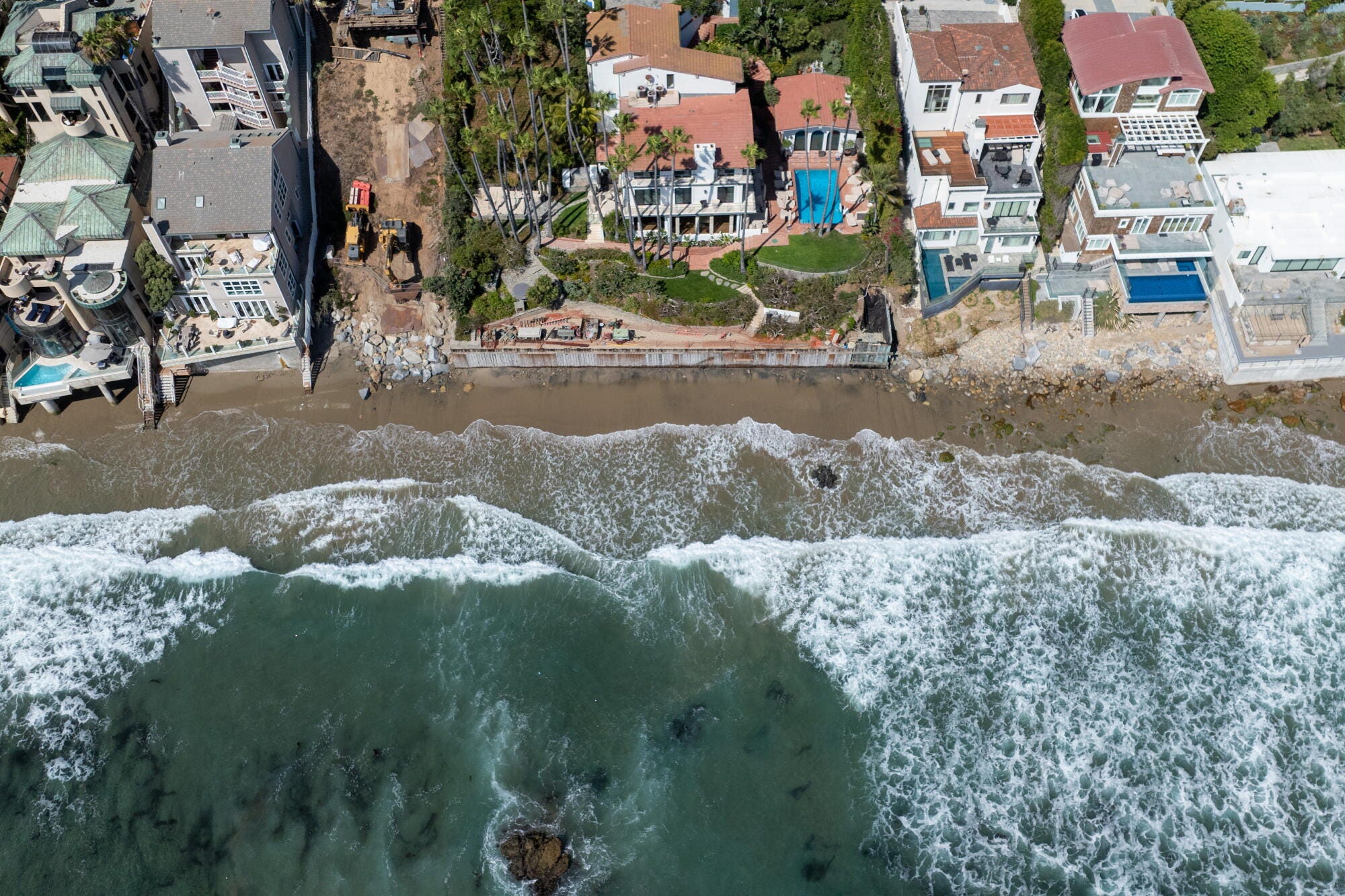
As El Niño intensifies and the Tropical Storm Rachel batters Southern California, coastal communities are once again confronting flooding, erosion and damaged property. Homes all along the coast have been destroyed. But much of the state’s vulnerability is the product of something far older than the latest storm.
*Source: Los Angeles Times, October 12, 2026: The Worst of Storm Rachel Has Passed, but Threats to Coast Remain
California has a peculiar habit of destroying its natural defenses, building over what remains, and then treating the consequences as an environmental emergency for which everyone else must pay. A recent study of the state’s coastal dunes tells that story rather well.
In July, researchers at UC Santa Barbara found that California has lost roughly 60% of its coastal dune area since 1850. Around Los Angeles and San Francisco, the loss exceeds 95%. Roads, housing, commercial development and other changes to the landscape account for much of it. These are not dunes that simply vanished in a storm. For the most part, California removed them.
*Source: UC Santa Barbara, June 22, 2026: California Has Lost More Than Half of Its Coastal Sand Dunes
Coastal dunes absorb wave energy, hold sediment, provide habitat and protect the land behind them. Yet California spent generations treating them as obstacles to development, then built expensive communities where those natural protections once stood.
Just look at the Southern California coast. Wide, groomed beaches run straight into promenades, highways, car parks, hotels and coastal property. It is an extraordinary tourist economy, and much of the natural coastline has been scraped away to accommodate it. What remains is an expensive and increasingly artificial landscape whose natural defenses have been sacrificed for “vibes.”
And when the damage becomes impossible to ignore, we know what will happen. There will be headlines about climate change, demands for another public spending program and lectures about our collective responsibility. Climate change may intensify coastal hazards, but it did not pour the concrete, approve the subdivisions or erase the dunes over the past century. Those were decisions made by people, usually in pursuit of the next property boom.
This is the larger California problem. The state has operated for more than a century on a boom-and-bust mentality, exploiting a landscape and improvising when its natural limits become expensive. Southern California has taken this to an almost absurd extreme. Tourism, property speculation and the entertainment industry helped create an enormous economic machine selling sunshine, glamour and the promise of a better life.
What much of it has produced is a sprawling collection of subdivisions, shopping centers and highways. Miles of suburban sprawl, surrounded by dry hills and dependent on imported water, populated by dead-eyed dreamers searching for something they will never find. The place is sold as paradise, but its a paer thin version of paradise. Perhaps its only paradise to the untraveled American.
There is an important distinction within California. The Bay Area, for all its faults and considerable dysfunction, remains one of the great centers of technological innovation in the world. Its universities, research institutions and businesses produce things of genuine consequence. Southern California has substantial industries of its own, but much of its identity and economy has been built around entertainment, tourism, real estate and the promise of a particular lifestyle.
Eventually, California will have to confront the difference between the wealth it has created and the liabilities it has accumulated.
Just look at wildfire. Fire is a natural part of California’s ecology, and no amount of forestry work can eliminate the danger of fires driven by extreme winds. But decades of inadequate fuel treatment in some areas and relentless building into fire-prone country have made an already difficult problem harder. Prescribed burns, sensible thinning, defensible space and better decisions about where to build are ordinary management tasks. They require competence and sustained attention, which seem to receive far less enthusiasm than another grand environmental announcement.
Water is another case. Southern California grew into a vast metropolitan economy in a dry region by importing water. Wetlands have been filled, watersheds altered and groundwater resources placed under pressure. The engineering required to sustain these cities is impressive at the time, but there is something fundamentally ridiculous about allowing development to expand while neglecting the natural systems that support it.
And then there is the rain. Southern California spends much of the year worrying about the absence of water, yet parts of it seem remarkably ill-prepared when substantial rain finally arrives.
In January 2024, San Diego received 2.73 inches of rain in 24 hours. Severe flooding followed, damaging neighborhoods and requiring more than 200 water rescues. It was an exceptional storm, but inadequate drainage and development in vulnerable areas contributed to the damage. After a century of urban expansion, one might expect a fairly large American city to have developed a more serious relationship with stormwater. Or how about this: can an American city even be considered a real city if they cannot handle 3 inches of rain in 24 hours?
*Source: City of San Diego, January 21, 2025: One Year Since Record-Breaking Storm
The problem is not a lack of money, expertise or technology. California has resources and plenty of scientific institutions. It can restore dunes and wetlands, improve drainage, manage forests, invest in water recycling and evaluate desalination where it makes economic sense. It can also stop rebuilding in locations that repeatedly demand public rescue and reconstruction. None of this requires a revolutionary environmental philosophy. It requires responsible planning, sustained investment and the willingness to tell developers no.
There is a conservative argument here. Protecting valuable natural assets, exercising restraint in public expenditure and refusing to socialize the costs of reckless development are basic principles of responsible government. A functioning dune system, watershed or wetland has economic value. Removing it to facilitate another development, only to demand taxpayer funding for expensive artificial defenses later, is dreadful economics.
California’s environmental reputation becomes particularly difficult to take seriously in this context. The state has spent decades congratulating itself on its environmental consciousness while permitting an extraordinary transformation of its own landscape. Conservation has too often become a matter of political identity rather than competent stewardship.
I have no objection to serious public investment in environmental restoration. I object to the recurring absence of adult supervision before the crisis, followed by the insistence that everyone else must help pay for the consequences.
The UCSB study gives us a particularly damning measure of what a century of this mentality has produced. California has eliminated most of a natural coastal defense that took thousands of years to develop. Much of what replaced it now requires costly protection from the very ocean that made the property valuable in the first place.
California has spent a century selling the world an image of paradise. As the economic realities of maintaining that image become harder to ignore, the state will eventually be judged not by its marketing or environmental rhetoric, but by the condition of the place itself. Before another disaster is blamed on climate change, Washington or the public’s unwillingness to sacrifice more, perhaps we ought to ask a simpler question: Where were the adults when all of this was being built?
If you want to read about California’s endless issues, check out my book: The Myth of California. The Amazon Kindle version was released in 2025, and spent a number of months as an Amazon bestseller (even #1 in a few categories).
Endorsements for “The Myth of California”
“California was once America’s “Promised Land” where people flocked to find gold, good weather, and opportunities in everything from movies to manufacturing. It was the agricultural epicenter of the world, known as the “salad bowl” of the planet. But decades of leftist leadership has destroyed everything but the weather. It’s become “Paradise Lost” with homelessness, unanswered crime, and choking tax rates and regulations causing people to flee in stunning numbers to get to places where their families can live without the boot of big government on their necks and cultural cuckoos setting the atmosphere of the lifestyle. Chad Hagan details what happened in his riveting book, “The Myth of California: How Big Government Destroyed the Golden State.” It’s the tragic story of how the irrational left destroys everything it touches and how one state exchanged its gold for garbage.
- Mike Huckabee, Former Governor of Arkansas, Bestselling Author, and U.S. Ambassador to Israel
“My father was a car salesman in a town of 800 people in Northern Minnesota. He had one vacation in his working life, and we took a trip to California. He had a friend who had settled in Carlsbad years earlier and wanted to visit. I was 10. My brother was 11, and our sister was 7. We were in awe. It was a modest home, beautifully maintained, with a yard full of fruit trees. We picked oranges and ate them in the yard. We had grapefruit off the trees for breakfast. I dreamed of moving to California for years. No longer! Chad Hagan’s book, The Myth of California, will make you disappointed, infuriated, and then just plain sad. It is a cautionary tale about how politicians can destroy a paradise in one lifetime. Ultimately, unchecked political power serves only itself. The citizens are included only to pay the bills. It is also a testament to how the crazies run the world. Most of us just want to go to work, come home and relax, and build a family and life. The crazies don’t think that way. They are loud, and they vote. Ultimately, politicians whose only interest is in power, cave in to them. (A government permit needed to wear heels taller than 2 inches in Carmel? Spare me!) As Californians now flee in droves, the stories they tell disabuse us of any notion of paradise. This book does that in spades. Read it!”
- John Linder, Former U.S. Congressman (GA-7)